Neutral Zones

In two weeks our new football stadium will host the 2018 NCAA Division II Football Championship.  After opening the facility last August to cross-town rivals and completing regular season play earlier this month, landing a college championship game has made this inaugural year definitely one to chronicle!

MISD Stadium

Aside from all the legend and lore that surrounds high school football in this state, the atmosphere and energy unique to the game is really something you have to experience to understand.  It’s a time when communities come together and share their passion for something, whether that “thing” is the competition itself, or the half time show, maybe the traditions, the sounds, the memories – something. And then there are the people, often as diverse as the reasons that brought them there to begin with.  Let me tell you about one game you likely didn’t attend and probably have never even heard about.

On March 24, 2007, the Winona State Warriors entered the MassMutual Center in Springfield, Mass., on a 57-game winning streak, were the reigning Division II basketball national champions, and were led by the two-time D-II player of the year.  They were overwhelmingly favored to defend their title against Barton College, a tiny school from Wilson, North Carolina, with an enrollment of less than 1,000.  The Bulldogs were led by Anthony Atkinson, a largely overlooked point guard whose 5’9” frame made coaches question how well he could transition to the next level.  On that night, he engineered one of the greatest comebacks in college basketball history, scoring 10 points in the last 39 seconds of Barton College’s 77-75 win.

He also has the distinction of being the first-ever player selected in the Harlem Globetrotters’ inaugural player draft.

Last weekend I took the family to see Anthony (now Ant) and the rest of his nicknamed teammates as they took on their constant companion rivals, the Washington Generals.  For the record, the Generals last victory over their “foes” took place in 1971!  In this Newsweek article on the history of the Globetrotters, you realize what trailblazers this organization has been for the past ninety years.  They have broken barriers on race, gender, culture, society, and more.  Beyond the pure talent and theatrics though, what really struck me about the evening was how, like our beloved football games, an entire community came together for a night of entertainment.  If you haven’t been to an event like this before, just know audience participation is a non-negotiable.  We saw kids of all backgrounds joining in on the fun, adults made to look silly, recognitions including a 25-year wedding anniversary, and a particularly special moment when a little girl sporting two prosthetic legs ran the length of the court to the cheers of the entire arena.  This is what the Globetrotters are about – bringing people together so they can get to know one another better in a safe space.  I don’t think our business is that much different when you consider our mission across generations.  As we enter this holiday season, let’s make sure our kids know about safe spaces where they can just be themselves.  Let’s make sure the adults know too!
Never Forget

Today is Veterans Day, a time we give thanks and celebrate the service of all U.S. military veterans.  It’s also a time of reflection on the many freedoms we are afforded because of those that have gone before us as well as those who continue to lead the way.  My calling was not the military though my father and father-in-law both served, and I am thankful for their service.  My superintendent also makes a very big deal about today as he uses his own platform to honor our servicemen and servicewomen in a public, yet truly personal, way.  I appreciate his leadership in reminding us all of why we should be grateful.

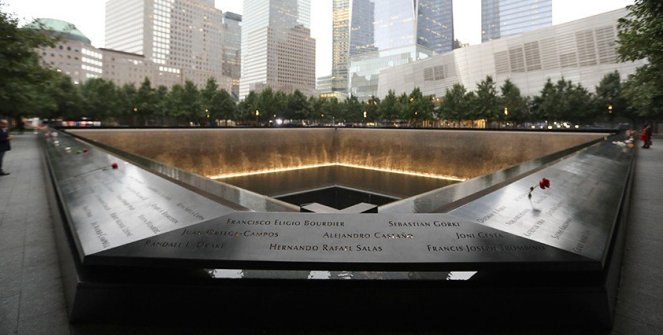
Each generation is connected to the way of the world differently I suppose and for me, 9/11 was the event that made the abstract all too real.  I was in high school during Operation Desert Storm and remember the yellow ribbon I, along with other classmates, wore to support our troops.  But to be honest, the “realness” of that conflict resonated exclusively because my biology teacher’s husband was a soldier stationed in Iraq.  I didn’t know enough and wasn’t mature enough to process the stakes at hand.  September 11th was just a different, once-in-a-lifetime changing experience.  For me, I was getting gas that morning when the news started coming in (I was at a local RaceTrac close to work).  In the aftermath, it stands as the single deadliest terrorist attack in human history and the single deadliest incident for firefighters and law enforcement officers, some 3,000 lives lost.  I saw the Pentagon nearly a month later in person, still smoldering.  I’ve been to Ground Zero and the subsequent National Memorial where the names of every person who died in 2001 are inscribed into bronze panels edging the Memorial pools.

911memorial_2

I was reading recently that Toby Keith, American country singer-songwriter, wrote “Courtesy of the Red, White, and Blue” in 20 minutes as both a reaction to 9/11 and in honor of his father, who was a veteran and died earlier that year in a car accident.  At first, the country music star considered the song too personal to record, singing it only in live performances, mostly for military audiences.  However, after being convinced to record it as a patriotic morale-booster during the build-up to war with Iraq, the song shot to the top of the country charts.  This was his calling and the gift he had to offer.

And finally, on a day to remember, Representative-elect Dan Crenshaw out of Houston, TX, provides the ultimate life lesson – forgiveness.  He’s a decorated Navy Seal turned politician who comedian, Pete Davidson, on Saturday Night Live poked fun at – you can learn all you need to know here.  Apologies followed and were accepted, and the game changer came when Crenshaw appeared on SNL and among other lessons, shared we should Never Forget.  In his closing, the two Bronze Star Medal / Purple Heart / Navy Commendation Medal with Valor Ivy leaguer said “and never forget those we lost on 9/11, heroes like Pete’s father.”

Platitudes and Attitudes

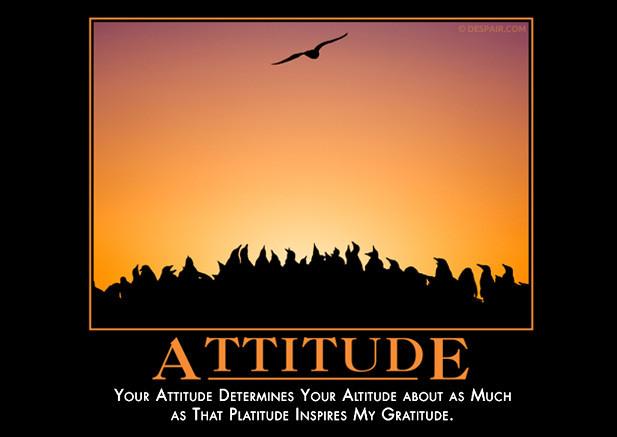
One of my go-to sites when needing a reality check is despair dot com.  It’s an online novelty shop that pokes fun at the retail motivational spin industry that sells hope in convenient office displays.  A signature product is their take on the inspirational posters we often see with a buzz word followed by a tag line.  I was remembering a favorite “demotivator” of mine earlier this week when listening to my son share his thoughts and reactions to a political advertisement he had seen on TV.

attitudedemotivator

I had read a quote while following coverage on the serial mail bomber by our commander in chief that claimed “a very big part of the anger we see today in our society is caused by the purposely false and inaccurate reporting of the mainstream media that I refer to as Fake News.”  It stuck with me too long and lingered and when my son commented that he disliked the tone of the commercials he was seeing and did not understand the reason [his words] “why all they do is talk bad about each other,” I realized he was 12 and I’m not and I’m wondering the same thing.  So I did a little research as I’m prone to do.

One of the organizations I’m affiliated with is the International Society for Technology in Education (ISTE) and, among other things, ISTE has developed a framework for school folks on how to rethink education and create innovative learning environments.  A major component of this road map addresses digital citizenship which attempts to promote safe, smart, and ethical decisions online.  Sam Wineburg, a Stanford University professor and lead author of a recent study that explored students and their ability to evaluate online information, gets right to the point.  “Many people assume that because young people are fluent in social media they are equally perceptive about what they find there.  Our work shows the opposite to be true.”  Consider this for a moment – a key finding from the Wineburg study – 82% of students can’t distinguish between sponsored and unsponsored content.  This was a 12-state, nearly 8,000 kid study, surveying middle school, high school, and college level students!

So when I hear calls about the true enemy of the people, I realize rhetoric is indeed rhetorical.  And if my kids and your kids and collectively our students are struggling with fact and fiction, maybe we can all benefit from reading a bit more from Dr. Wineburg’s research.  What can we do better to engage students in legitimate debate on topics of interest that honors and respects differences in their discourse?  As moderators, how do we tailor our own bias and not just meet kids half way, but go more than that proverbial mile?  Though the picture above was pun full intended, engaging each other’s cooperation is a universal survival skill we can never get too right.

Keep the Change

As a student of statistics, I’ve learned that a confidence interval is the surest way to report on a sure thing!  Today, however, I am going to predict a 100% chance of rain :-).  It’s pouring outside right now and it’s been like this all week.  We left behind one of the hottest summers and rolled into the wettest fall on record.  Central Texas has been hit particularly hard with devastating flooding and reported fatalities, and videos like this one showing live coverage of a bridge collapsing as the Llano River bears down on it.  Most of this excess water has flowed into the bloated Lake Travis, now filled to 132 percent capacity and engineers have started opening a series of control gates to relieve the water pressure.

It has been a little over a year since Hurricane Harvey made landfall in the Houston and southeastern coast area, becoming one the costliest storms of all time with $125 billion in estimated damage. Besides the enormous amount of rain, recovery was immediately complicated by Hurricane Irma, which hit Florida, and Hurricane Maria, which devastated Puerto Rico, because FEMA and other federal agencies had to share their personnel and other resources.  I remember at the time thinking back to Hurricane Katrina and how it forever changed New Orleans and the gulf coast.  Katrina was personal for me as it hit my home state and became professional when evacuees were ultimately routed to an abandoned Walmart here after being displaced from the Superdome, then Astrodome, and finally Reunion Arena.  Overnight our city grew by 400 residents, some 250 being school-aged children.  As part of the district’s response team, I helped to enroll these students onsite at the makeshift shelter the Walmart had become.  They came with no records, no belongings, and for some, your heart just ached because they were unaccompanied.

I suspect the memories of 2005 resurfaced when Harvey hit and I remember sitting my boys down one evening for a teachable moment.  In the context of change, I was trying to reassure them it wasn’t about what happens to you in life but how you respond that matters the most.  Change is hard and there is comfort in routine.  As I leave for work every morning, I put on the same watch my parents gave me when I graduated from college and the same ring my wife gave me shortly thereafter.  Both of them rest each evening in a leather valet tray that sits on the counter by the back door.  So I asked my boys if disaster struck and you could only save one thing, what would it be?  I told them for me, it would be that leather valet tray because when I see it I know I’m home, wherever that may be.  What artifacts do we similarly allow students to find comfort in?  As we collectively send safe thoughts down south to the flood victims, and as folks in this business, we know the school house needs to reopen and routine needs to be reestablished.  Principals model this every day as they are often the first person kids see when they arrive and the last when they leave.  If we know we have to keep the change, maybe we can share the constants a bit more.

AI + IQ + EQ = ???

Last week I had the opportunity to attend an event with our director of instructional technology and chief information officer on digital transitions.  The symposium was intended to unpack the EdTech landscape and lay out strategies for sustainability.  What it became was a polished bait-and-switch marketing front for vendors (ahem I mean solution providers) to distribute sliced bread.  By the time we reached the “alien incursion data literacy game,” we decided it was time to go!  On our way back from the event we reminisced about this age of technology we are in and when each of us entered it.  For me, the Canon NoteJet 486 was the MacGyver of all advancements (the Swiss Army knife of cool).  I mean really – it was everything perfect.

Later that afternoon in the office I did a quick internet search to basically remind myself of how hip I really was back then for having the NoteJet and found this write-up in PCMag, arguably an authority on such matters:

“7 Bizarre FrankenPCs That Are Better Off Dead”

Cannon’s strange-looking NoteJet 486 stands out in the annals of weird notebook history due to its integrated BubbleJet printer (Canon’s trade name for its inkjet printers) that printed three pages per minute. This 7.7-pound computer also sported a 9.5-inch monochrome VGA display and a 486 CPU for around $2,500. (And if you were so inclined, you could also buy that neat trackball remote thingy.)

392897-canon-notejet-486-1993

So I decided I was done with artificial intelligence (AI) at that point and needed to employ more self-help strategies to cope with the realization that my glory days may have yet to come!  And then I went two for two when reading about the “dark side of emotional intelligence” in this article by The Atlantic.  Many of you are familiar with the term emotional intelligence which has gained mainstream popularity and originates back to efforts to formulate an emotional quotient (EQ).  To oversimply, EQ sought to balance and temper IQ, the idea being that it’s maybe just as important to be able to read the room as it is to read in the room.  I was reminded of this social construct earlier this week in conversations about smart kids who do not so smart things.  As we become more and more dependent on various technology, perhaps now more than ever the skills required to build relationships become most important.  When did text etiquette replace the rest of etiquette?  And as shepherds for young people, do our values and beliefs align with what we expect from them?  These are their formative years and as such maybe it’s the setbacks that generate the best solutions.  And maybe part of our role then is to be “space providers” while they wrestle with their multiple intelligences.

Marshmallows

My senior year in high school I took a two-part class with one semester on psychology and the other semester on sociology.  Psychology was in the fall and by the time I started college it was a declared major.  The study of the mind just seemed to connect with me on many levels and so I continued to learn as much as I could through my undergraduate and graduate pursuits.

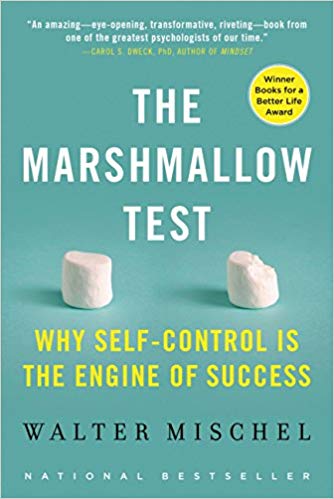
Last week, Walter Mischel, at the age of 88, passed away.  If you’re not familiar with arguably one of the most influential modern-day psychologists, you may have heard of his signature research on self-control and will power.

More than five decades ago, Mischel and his colleagues began working with four-year-olds in a series of experiments to test their ability to delay gratification.  Preschoolers would be presented with two marshmallows and told if they could hold off on eating one for fifteen minutes while the researcher left the room, then they could have the second one also.  If they wanted to not wait and eat just one, they would simply ring a bell for the researcher to return before time was up.  Fewer than one in three children could hold out!  Some of the control groups, however, did much better in delaying impulse when they were provided strategies for shifting their attention.  Years later, Mischel and his team followed up with the preschoolers and found that children who had waited for the second marshmallow generally fared better in life.

The research sought to identify the cognitive skills that underlie willpower and long-term thinking and how they can be enhanced.  Mischel’s aim was not to predict who would be successful or not but rather how can people be trained and empowered to control their own attention and thoughts.  In a more recent NPR interview, he sums it up himself the best I believe.  “What my life has been about is in showing the potential for human beings, to not be the victims of their biographies — not their biological biographies, not their social biographies, and to show, in great detail, the many ways in which people can change what they become and how they think.”  Mischel sounds like a rock star teacher to me!  His work has often been misunderstood and he wasn’t suggesting one’s destiny is determined by a sweet treat.  He was trying to show the world the power of thought and how it can shape one’s future.

TheMarshmallowTest


Character Revealed

On Saturday, 09/08, Naomi Osaka defeated Serena Williams and became the 2018 U.S. Open women’s singles champion.  The twenty-year-old phenom claimed her first grand slam title along with a historic $3.8M victory check (Williams, at age 36, has 23 major victories).  If you were like me, you read about this feat the next day sifting through all the controversy that also surrounded the event.

To quickly recap, the first ever Japanese-born grand slam tennis player bested her childhood idol in every aspect of the game.  Osaka dominated Williams, claiming a 6-2, 6-4 straight set victory.  But what has overshadowed Osaka’s brilliant play was a series of exchanges between Williams and the chair umpire during the second set.  With Williams down one set and just into game two of set two, the official proceeded to charge her with a code violation.  The first resulting penalty was a warning to Williams for allegedly receiving coaching (coaches are not courtside but in the stands and during the big events are not allowed to instruct their athletes).  Williams contested the warning but kept playing and was able to establish a 3-1 lead before quickly surrendering the momentum by losing the very next game.  Now the game count stood at 3-2, and Williams smashed her racket on the ground while walking off.  This outburst led the chair umpire to assess her with her second code violation and resulted in the loss of a game point.  Osaka went on to win that game and square the set at 3-3.  When she proceeded to win the next one as well Williams’ emotions boiled over and she laid into the chair umpire during the changeover.  At this point the official called another code violation on Williams for verbal abuse, and the resulting penalty was the loss of an entire game, instantly changing the score from her being down 4-3 to being down 5-3.  Osaka would go on to claim the second set 6-4 and the match.

Earlier this week, Osaka was invited to appear on The Ellen DeGeneres Show and the six-minute feature was pure inspiration in its simplicity.  The tennis star was poised but clearly nervous and out of her comfort zone.  And to Ellen’s credit, she immediately made their time together about Osaka, the college-aged kid who happens to have enormous tennis talent but many of the same interests and insecurities as her peers.  When asked about what Williams quietly shared with her following the match, Osaka revealed her idol said she was proud of her and you could see the profound impact that affirmation had on her.  As educators, how often have we seized on timely moments and made lasting impressions?  Small gestures aren’t necessarily simple ones.  And as observers, how often have we seen these exchanges take place? The scene that unfolded at last Saturday’s U.S. Open was raw and ugly and unsettling, yet two champions emerged.  That should be our end goal every time.

Heat Islands and Food Deserts

Today is my birthday and it seemed like as good a day as any to launch this site.  As a public school administrator, my route to this role has been less typical but in most ways, it has been by design and desire.  What I’ve learned along the way is I usually have an answer to a question, it just might not always be the right one for a given circumstance.  This is where you, the reader, come in.  My goal for this blog is to present topics of interest (hopefully) and through audience participation extend the discussion.  And maybe this exchange will lead to a new “what if” or “why not” that makes this day more informed than those before it.

It’s hot in Texas!  We’re a week into September and still seeing 90 degrees outside.  Forecasters have already indicated the Lone Star State is on track for the second hottest summer on record, trailing only the record-breaking year of 2011.  But despite the heat, I have choice in how hot I choose to be.  The temperature in my house is set at 75 degrees and the master bedroom stays at 73 degrees, with fans no less.  I come to work early and leave late, all while in a comfortably cooled office.  On weekends the outdoor and leisure activities definitely change things but I like it that way.

I came across an article recently that suggested poor city neighborhoods are often much hotter than wealthy ones (The Washington Post, 09/02/2018).  Beyond the more obvious reason for this due to affordability of air conditioning, low-income areas are prone to “heat islands” which is a term used to represent communities with little vegetation and lots of concrete.  They lack greenery, public parks, adequate landscaping, and so forth.  These parts more often lack indoor respites like movie theaters and malls and share another phenomenon – food deserts.

After I read this article I went for a drive around town and randomly toured some of our schools.  I’ve always paid particular attention to a school system’s buildings and grounds because I believe it says a lot about an organization.  Neighborhood schools are just that, and we often discuss the bell-to-bell order schools provide to students in otherwise stressful circumstances.  Imagine if the school house not only was the source of social emotional comfort but also that much needed physical comfort we may not have recognized.  Certainly this year has offered new excitement as we welcomed kids back and even though there are many variables beyond our control, paying attention to the details is a responsibility we can all share.