Legacies and Leg Room

Today marks the end of the first full week of a new school year and I am always reminded of Plato’s words of wisdom – “the beginning is the most important part of the work.”  Summer never seems to come fast enough and then it’s gone before you know it.  And for most folks in the school business summer months involve wrap-up activities from the previous year and warm-up activities for the coming one.  Start – Stop – Repeat!  I suspect right now there are more than a few teachers feeling the drain and humming to the song of my son’s favorite band – “in the end it doesn’t even matter.”  They don’t really believe that, none of us do, but there’s nothing that humbles like a well-planned day that goes sideways.

So for those of you that had a typical adventurous start welcoming new and returning students, maybe take a moment and laugh with the Holderness family.  My wife and kids first laughed along with this troupe during the Christmas holidays in 2013.  At the time much of the world was introduced to them while they were wearing their Christmas Jammies.  Since then the husband-wife television personalities who left their day jobs to start their own video production/digital marketing company have produced dozens of funny videos, among other things.  Their latest parody was just released and relatable for sure – click the picture below if you’d like to check it out.

ByeByeBye

When I visit with staff across the school district regardless of the position he or she holds, without fail there is a common desire to make a difference in the lives of today’s youth.  We all hope there is an inherent social good in public education.  For those of us making it our life’s work, we also hope to add value in meaningful ways.  This leads me to legacies – those footprints or impressions that survive the day-to-day grind.  For me, I’m not so concerned with being remembered – I don’t need to be referenced or revered.  I just don’t want to be forgotten and that seems to be enough motivation to work today on improving tomorrow.  For me, it’s about leg room.  Did I clear a path for others to follow and was that path wide enough?  If it wasn’t, what am I going to do about it?  We talk a lot about equity and access in schools because neither are givens without constant vigilance.  As we kick off another great school year let’s check the aisles to make sure there is enough room for everyone.  And when you get home after a long day that started in the dark and ended in the hot (come on rain!), check out these back-to-school dinner ideas!  🙂

Grow Dang It (please)

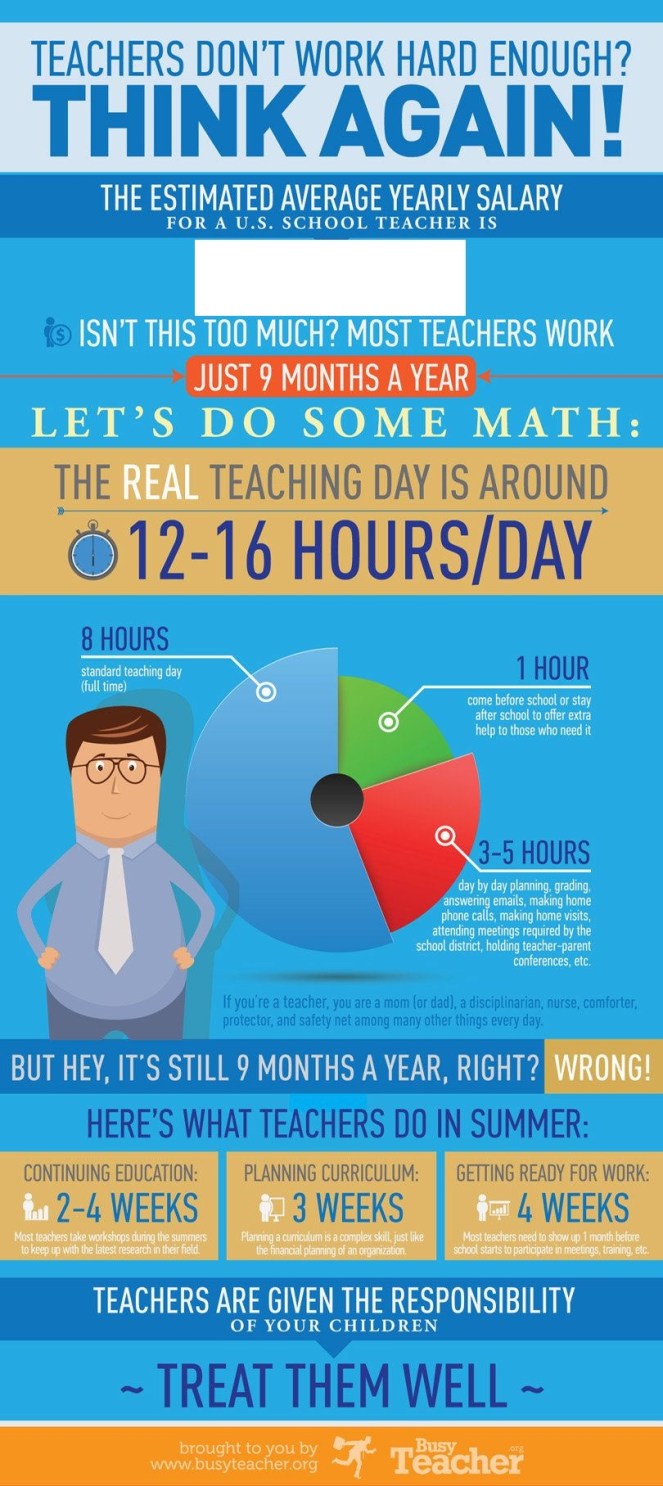
Summer is finally here!  Well, not quite – it officially starts this Friday but it’s still hot and will tip north of 90° today.  We made it through the school year, graduations, end of the year procedures, and beginning of the year planning.  And for teachers, as I’m learning first hand, summer presents lots of “growth” opportunities.  As I was doing some research for this post, I came across the following infographic (source cited in illustration):

Teacher Salary

I intentionally shaded out the salary because that’s a topic for a later day (or new biennium for those following this past legislative session).  What I wanted to highlight here is how school systems try to build capacity through professional learning.  And based on many factors, these efforts tend to load up during the summer months.

Tomorrow we kick off our district’s annual digital learning event now entering its fifth year – Converge. This summer showcase of best practices is the brainchild of our instructional technology team in efforts to create a unique conference vibe in our own backyard and has grown to be quite successful.  We invite teachers to share lessons learned with their peers, bring in leading experts on engagement and student learning with a particular emphasis on the technology intersection, open the doors to area school districts, and most importantly, make the learning fun for big kids along with the younger ones in some cases.  This year’s event will be held at one of our high schools and has a carnival theme.  Readers can watch a short video clip by clicking here.

Converge

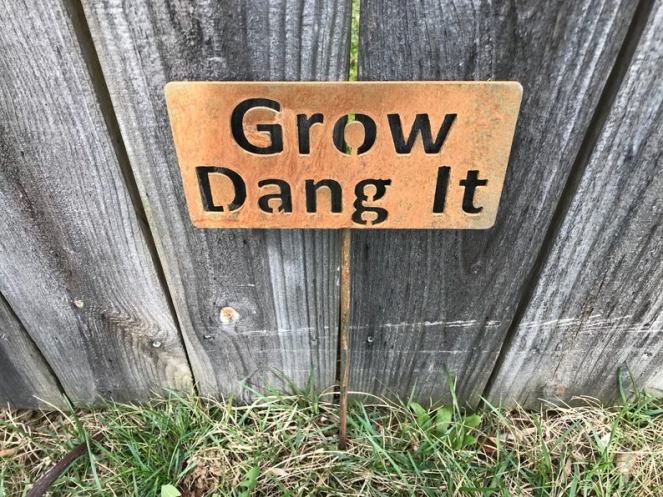
So what have I learned observing this event and lending partial support in the planning after five years (as a disclaimer I missed year 1)?  Well, for starters, much like the garden sign below that my wife shared with me in introducing one of my summer projects, the difference in compliance and commitment can never be understated.

Grow Dang It

If you want to help teachers grow, it needs to be on their terms and presented after much thought.  I can attest to the hard work and attention to detail the three visionaries running our IT shop have put in to pulling off this event.  Oftentimes when we debriefed during planning sessions I would start relapsing into my “this is silly and stupid” bubble in response to some of the activities they were planning to which these ladies in sync would point out maybe I was the silly/stupid one.  We had several of these touché moments made possible because in general we have a strong enough circle of trust.  I’ve also come to accept Murphy’s Law and inevitably things happen.  The next lesson I’ve learned is it helps to know people, particularly the right people.  Just this morning I spent time in a conference call with our facilities boss in what started out as an SOS dispatch yet ended with a solution and additional support.  In any business, you need to know your solution providers.  And finally, when you compete for people’s time, be a winner.  We’re building capacity tomorrow with 750 leaders in education who are growing this profession (and we didn’t even have to say pretty please).

If You Want To Build A Ship

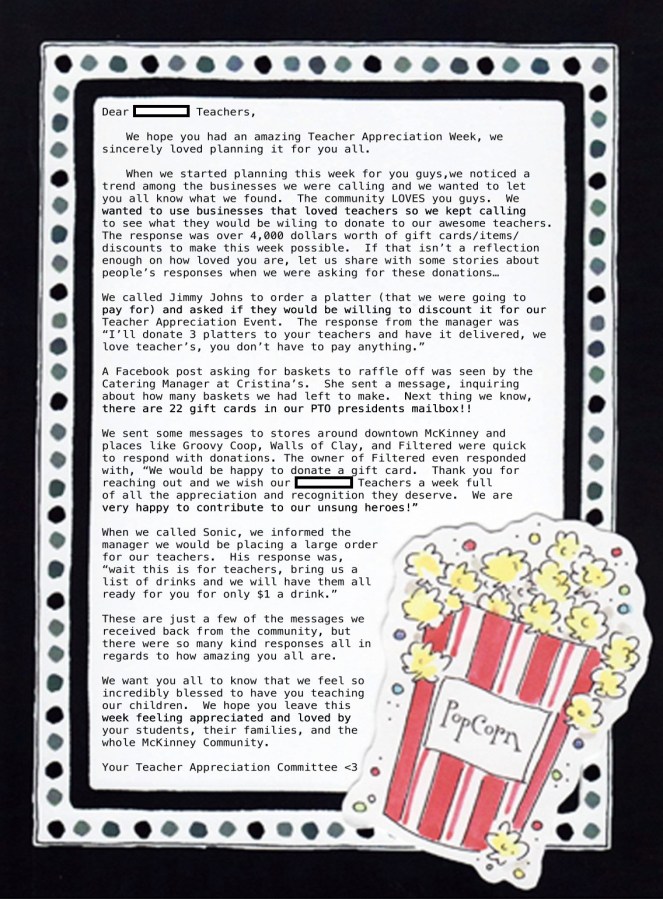
Did you thank a teacher last week?  What began as a congressional day of recognition in 1953 and then an official national day of observance in 1980, National Teacher Day falls annually on the Tuesday of the first full week in May.  In 1985, the National PTA extended the observance and established Teacher Appreciation Week as the first full week of May.  My wife is a career-two, year-two 1st grade teacher at one of our local neighborhood elementary schools that has the distinction of being the only choice school in our district.  Like many of our schools, diversity is one of its greatest strengths and she shared a letter with me that the local parent-teacher chapter had penned for her and her colleagues.  As she read the thoughtful tribute, it reminded me of a teacher testimony I had seen on an online clearinghouse where teachers post funny things students say:

On the last day of the year, my first graders gave me beautiful handwritten letters.  As I read them aloud, my emotions got the better of me, and I started to choke up. “I’m sorry,” I said. “I’m having a hard time reading.”  One of my students said, “Just sound it out.”

I suspect all educators who follow my blog site may have a similar reaction after reading the letter below.

Letter2

I mentioned last time based on my own assertion that teaching is one of those few professions in which everyone probably has a direct relationship with in some capacity, and I was struck by the great way these partner parents weaved the planning logistics for the week into a one of a kind morale booster for some surely tired teachers (we’re in the last month of the school year!).  And the examples of local business leaders being quick to respond with support provided a slice of renewal in its affirmation.  One of our solution providers even provided a creative wallboard by asking their staff to share their stories of a teacher who made a difference in their lives.

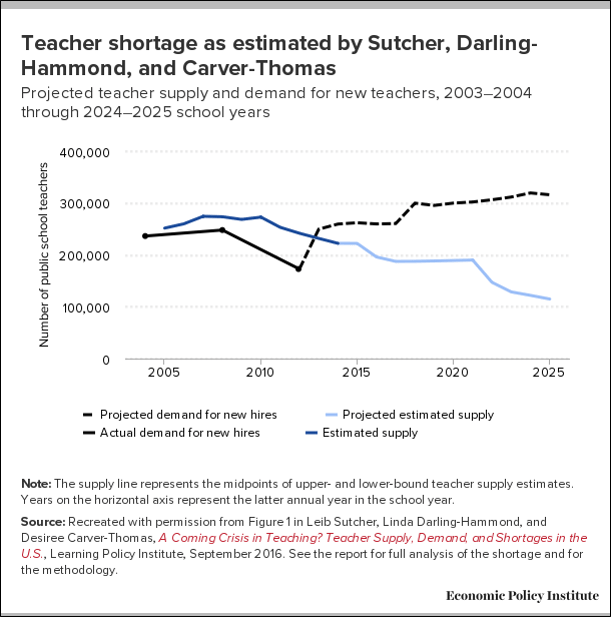
So what do you make of this seeming contradiction?  While nearly two thirds of respondents have trust and confidence in public school teachers, a majority of Americans said they would not want their child to become one.  These findings are part of the latest results in the PDK Poll of the Public’s Attitudes Toward the Public Schools, arguably the most trusted source of public opinion about K-12 education dating back to 1969 when the annual survey launched.  Consider this for a moment, when Americans were asked 50 years ago – ‘Would you like to have a child of yours take up teaching in the public schools as a career?’ – 15% selected ‘No’ as their response.  In the latest report, the percent of naysayers had climbed to a record 54%.  It should come as no surprise then that current estimates on teacher shortages tip north of 100,000 with projections to double by 2025.

TeacherShortage

It’s hard work being a parent to two – I can’t imagine extending that same care and concern to twenty or more every day.  I don’t believe teaching is a thankless profession but the demands and expectations may often go unrecognized.  In what other industry do students at the earliest ages learn to make sailboats out of nothing more than construction paper, pool noodles, and straws while learning about density, displacement, and buoyancy?  I know of at least one 1st grade shipwright who will teach you the same.  Thank a teacher and not just on the Tuesday of the first full week in May!

Where Amazing Happens

This week I’m in Austin attending a professional gathering for senior cabinet members and district administrators from across the country discussing innovation in teaching and learning and how to maximize current technologies and funding to advance student achievement.  It’s an intimate event with only 100 attendees and I was invited to present on effective strategies for organizational improvement.  Admittedly, discussions around accountability, performance excellence, and key performance indicators aren’t always met with wide appeal.  In public education, a structure inherently designed to promote social good, outcome-based dialogue can vary dramatically and consensus on defining success is often difficult.  Teaching is one of those few professions in which all members of a given population have probably had a direct relationship with, in one setting or another.  And when people talk about the work of schools, they generally do so through some shared experience.  My presentation topic doesn’t lay out how we should define success for our schools but rather offers a framework that can be tailored to systems of all size.  For me, these ideas have been shaped by more than 15 years leading this work, including time in one school district that was the recipient of the Malcolm Baldrige National Quality Award, the nation’s only presidential award for performance excellence and innovation.  Named in honor of the 26th U.S. Secretary of Commerce, Baldrige is quoted as saying, “Success is finding something you really like to do and caring enough about it to do it well.”

The NBA playoffs began earlier this month and I remembered a slogan the league once had – Where Amazing Happens.  For two all-time basketball greats, their final career games took place on April 10th when the regular season ended.  Dirk Nowitski and Dwayne Wade are two modern-day athletes that transcend the world of sports and have been community stalworths for social good.  For Dwayne Wade in particular, he knew as he began his sixteenth season it would be his last.  And as part of his farewell tour he began swapping jerseys with opposing players he had a connection with, through friendship, greatness, respect, and beyond.

Dwayne and Dirk_v2

In the end, he had exchanged over 40 jerseys but the last five brought the future hall of famer full circle.  In a surprise tribute to Wade, five people took turns thanking him for his role off the court:  a woman who Wade took shopping when her house burned down around Christmas; a woman who got to go to college because Wade paid her tuition; a troubled young man who turned his life around with Wade’s guidance; a sister of a student killed in last year’s Parkland school shooting; and finally, Wade’s own mother provides the ultimate show-stopper testimony.  This four-minute video reminds us that some of Wade’s most memorable impacts are the ones he played in the lives of others.  Sometimes you have to reframe the optics to see success.  Even harder, you may have to be patient and let success present itself to you.  In the end, I’d like to think amazing can happen anywhere.

Making Lemons out of Lemonade

I’ve spent the last two postings discussing school funding and based on my site visit statistics, I need to find another topic!  I began my career serving students with disabilities and was drawn to this work largely because I thought there was a need and it mattered.  I still feel that way…

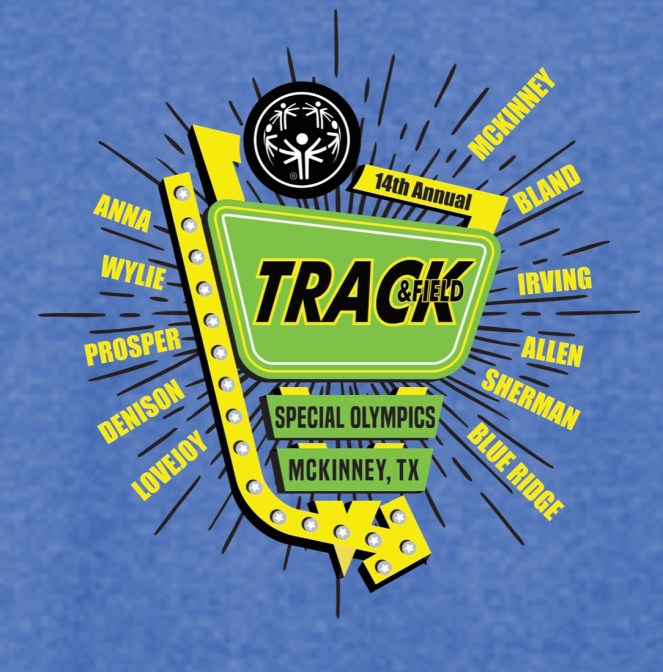
This week a couple of news items caught my eye and stuck with me.  The first issue was prompted by the budget proposal from our current federal secretary of education which included eliminating funding for Special Olympics.  To be clear, her punch card for school choice, school voucher programs, and charter schools, probably does influence this public school administrator’s opinions.  Regardless, her proposed cuts to these athletes struck a nerve.  I suppose it didn’t help matters that one of my dear friends specializes in adaptive physical education instruction and also coordinates the regional Special Olympics meet within our area for students which our district serves as the host site.  The upcoming competition will have over 340 athletes with special needs locally and over 450 additional athletes with special needs from the region.  Even more brag-worthy, we will be the largest local Special Olympics track meet in the state of Texas.  This is year 14 for this local event so I called my friend and asked a couple of basic questions – you should consider supporting them if you can, https://mckinneymavericks.org/.

Q1:  Why do you do it?

I believe it’s just a lot of what the world needs and I see the impact it has on families.

Q2:  Why does it matter?

A2:  Special Olympics provides an avenue for everyone across a broad spectrum – it builds a community.

She’s right by the way.

2019 Track Meet Shirt

The second issue I read about this week dealt with proposed legislation to legalize lemonade stands.  Honestly this one stumped the noggin as well.  It makes a little sense if you stick with the narrative long enough but still seems like overreach.  It turns out a lemonade stand, like any makeshift business, runs afoul of city permits and lacks proper inspection from the health department.  I get it, I guess, but I still admire the kids for their stick-to-it-ness.  You should make time to watch 8-year-old Branson Burton as he testified (on a step stool) in front of the Texas House State Affairs committee in support of legislation that would let him keep selling lemonade.  By his own account, he netted a nifty $246 profit before getting shut down.

As folks in the business of advocating for other, let’s keep advocating…

School Funding – Part 2

In my last posting I introduced the topic of how public education is funded in Texas and I wanted to revisit that conversation.  By way of brief update, the legislature has established a basic allotment per student and then a separate “tier” of funding for program enrichment which addresses students needing a continuum of special services.  That basic allotment (or tier 1) currently guarantees $5,140 per student per school year which is the state’s attempt through wealth equalization to ensure some level of consistent funding.  Tier 2 funding is supplemental and dependent upon the needs of a given student population.  This “program enrichment” allocation is designed to provide additional resources for students requiring special services, such as special education, bilingual education, career and technical education, and gifted and talented education.  In sum, when you factor in our general operating budget, it costs on average around $10,000 a year to educate a student in our district.  Though a portion of our revenue comes from the state via sales tax collection, that portion this year was approximately 15%.  This means that 85% of our revenue (money needed to balance the budget) was generated through local property taxes.  In simpler terms, we’re collectively expending approximately $55 per instructional day to ensure a child can come to a public school.

I quoted Ben Franklin previously who is credited with saying “an investment in knowledge pays the best interest.”  We’re wrapping up the third marking period today in preparation for spring break so all grades are being finalized as I type.  Like many parents, I have created some monetary incentives for my boys to do well in school but also to recognize their efforts through some tangible gestures.  There have even been research experiments conducted that explore the benefits associated with direct incentives for attendance, behavior, coursework, etc.  Consider the following chart from the U.S. Department of Labor, Bureau of Labor Statistics, as a time-tested concrete example:

Median Weekly Earnings

It has always been a pretty safe bet that the more you learn, the more you earn.  The chart above seems to make a pretty compelling case for this argument.  On average, a person with a bachelor’s degree earns around 65% more income per week than a person with only a high school diploma.  A person with an advanced degree can average as high as 158% more income per week.  In dollars, we can estimate a high school diploma affords an annual salary of $38,000 compared to $62,000 for a bachelor’s degree and $98,000 for an advanced or professional degree.  More recently, our state education agency has adopted a broad “College, Career, and Military Ready (CCMR)” focus to recognize the multiple pathways students can pursue towards postsecondary success.    If you spend some time browsing the related content and subjects on the Labor site you’ll see a variety of outcomes based on education decisions.  They even offer a light-hearted spin to the iconic Game of Life board game with their own online version that is intended to help users make informed decisions about some really important matters.

At the end of the day (and more precisely a school year), I’m not sure if a $10K investment is too little, too much, or just right but I’m pretty sure it’s not for me to decide.  I will say this though – I’ve never had a student (child) tell me that he or she was provided too many opportunities…

School Funding – Part 1

Earlier this week I had the opportunity to attend a joint meeting between the city and the school district.  Each year leaders from both entities come together to share their respective agenda priorities on matters ultimately significant to the larger community.  It’s also a chance to put faces with names we know such as the mayor or city manager or council members to our board of trustees and superintendent along with senior staff that support a variety of city and school functions.  Several topics were discussed but the two that loomed large were school funding and property tax reform.  Texas is one of seven states with no income tax and consequently relies most heavily on sales and other taxes for its revenue stream.  At the local level, revenue is primarily generated through property taxes.  This spring, lawmakers are in session to adopt the state budget that will guide Texas for the next two years and public education represents the biggest share of the state’s general revenue spending.

School funding is supported by taxpayer dollars and a new report released by the state comptroller indicated that roughly 38 percent of public education funding came from the state and 62 percent from local sources.  But the overly complicated formula used for calculating funding to schools can be analogous to filling a glass of water – if I put more water in then you have to put in less; if you put more in then I have to put in less.  This inverse relationship captures the essence of current debates as property values continue to skyrocket.  Consider this for a moment, the average single family home value in our city in 2013 was $221,821; fast forward to 2018 and it’s $342,657, an increase of nearly 55%!  Now let’s do some property tax math based on this figure and our current local school district tax rate:

PropertyTax2

In addition to this amount, property owners can have taxes levied by the city, county, and local university.  Funding our schools is a shared responsibility although the state determines how much total funding each school district is allowed to have.  The legislature has established a basic allotment per student and then a separate “tier” of funding for program enrichment which addresses students needing a continuum of special services.  The goal is to ensure that a student’s ZIP code doesn’t determine his or her educational opportunities.  Districts first use local tax dollars toward meeting this allowable amount.  If a district is unable to raise the allowable funding level locally because it doesn’t have a wealthy enough property tax base, then state dollars fill the gaps.  If a district is able to generate more funding locally than allowed by the state’s formulas, then the excess property tax revenue collected locally is “recaptured” or sent back to the state for redistribution to other school districts.  This is what is known as the “Robin Hood” provision and arguably the rule that generates the most controversy.

Ben Franklin once said “an investment in knowledge pays the best interest.”  Next time we’ll examine the evidence that supports this claim.

Congratulations Class of 2019!

Last weekend I was invited to deliver the keynote address to graduates from a non-traditional high school.  I’ve participated in commencement exercises before but this particular one was my smallest by far yet proved to be the most stressful.  Big crowds typically have too many distractions for you to capture an audience’s attention for an extended period so as long as the wheels don’t completely fall off they’ll clap when you are introduced and clap harder when you finish.  This event was different and maybe, just maybe, I could give these students something to think about the next day.  In the end, I’ll let you be the judge as I’m sharing the transcript below…

Good Afternoon.

As mentioned my name is Geoff Sanderson and it is an honor to be asked to participate in today’s ceremony.  I mean that.  Oftentimes these types of speeches attempt to offer profound insight into lessons learned.  They go something like “don’t be me, be you, but let me tell you how to be you.” 

Right?

Or

“I’m here to tell you about the real world you’re about to enter as you leave behind the pretend world you’ve been living in.” 

I’ve had the opportunity to participate in these types of ceremonies in the past and I’ve even delivered those same types of speeches I just criticized unfortunately.  The venues were large, crowded, and impersonal so I was pretty excited when your principal invited me to your graduation ceremony.

It is yours by the way.

You students have obviously demonstrated resilience based on the milestone we are here to recognize and I would encourage you to share this day with those of your choosing.  The credit is ultimately yours but I suspect many people have supported your efforts along the way.  I would argue though today is not a capstone event and the differences are anything but subtle. 

I am a school psychologist by trade although my work these days is much less practitioner-based.  I do spend considerable time in research on a variety of matters that impact the learning process.  One of the contemporary pioneer psychologists I continue to follow is Carol Dweck who gained popularity over a decade ago based on her published theories around mindset, that is, those beliefs that you hold about yourself and your most basic qualities.  She is a living legend for people like me and I’d like to describe her ideas a little bit more.

And full disclosure, I am about to attempt to impart some wisdom while confessing that I am notorious for telling my own parents that free advice is worth every penny. 

In her earlier studies, Dweck identified two types of mindsets, fixed and growth.  In a fixed mindset, people believe their basic qualities, like their intelligence or talent, are simply fixed traits.  You either have it or you don’t; it can’t be changed.  In a growth mindset, people believe that their most basic abilities can be developed through dedication and hard work – brains and talent are just the starting point.  To illustrate, she describes two ways to think about a problem that is slightly too hard for you to solve.  Are you not smart enough to solve it … or have you just not solved it yet?  That captures the essential difference between the two paradigms.

Okay hold that thought.  I’m not going to spend our remaining time (they say all good speeches should cut at about the 10-minute mark) I’m not going to spend our remaining time citing big ideas from more than a decade ago.  So enough of that already.

Here it is – listen closely.

YOU NEED TO FIND YOUR PASSION.  Students, that’s terrible advice.  Let me tell you why (I’ve studied the research on this as well)…

This notion that we have built-in interests lying dormant and waiting to be discovered is a myth.  That once you uncover it, your road to happiness is firmly cemented.  Your calling in life is not hiding in the dark and all you need to do is look for it.  If that were the case we’d be handing out flashlights along with your diplomas.  You’re passion isn’t lost; it’s something you come to understand.

The illusion that interests are fixed is problematic because once you find it and you hit a snag, which you will, you’re left with no plan B.  You know you have the power to make changes.  You’ve proven it.  While we can’t control everything about our lives, there are many facets we can control.

I would encourage you to be curious and open to new ideas.  Don’t narrow your focus on any one thing because you may miss developing knowledge in other areas that you could have called upon at a later date.  Success will more likely await those who take the time through investment and persistence to cultivate and grow their passions in a variety of areas.  I do not believe there is only one thing you were meant to do.  To prove this point, I’m going to ask for some quick audience participation.  Now I realize the inherent risks associated with an impromptu survey among new found friends, but I have confidence in this crowd.  By a show of hands, either your left hand or your right hand or both, how many of you can do more than one thing well?  Adopting a growth mindset won’t turn you into a superficial generalist.  That saying, a jack of all trades is a master of none, isn’t all there is to the expression.  The original saying was “a jack of all trades is a master of none, but oftentimes better than a master of one.”

Now more than ever we need bridge builders and I hope you find the courage to share your unique gifts with a diverse group of others.  And if you do surround yourself with them, be sure to listen to them, debate with them, even argue with them, but do so respectfully and let them have their say.  Your opinions on matters of great importance are learned through study and experience, and I promise you, the truths you know today may not be the same truths you know tomorrow.  Give folks the benefit of the doubt and that starts first with you.  What I pray for my own children is not that they rule the world, but that they root it.  This life is about choice, your choice, your freedom, your right.  Always remember the strength that got you here today. And, in the immortal words of Mr. Miyagi, “Never put passion in front of principle.  Even if win, you lose.”

Thank you.

Legacies That Live On

You should Google Paul Allen.  Then Herb Kelleher.  The first search will get you three quarters of the way to a billion results so if that many zeros seems intimidating start with the second name then (you’ll only have to parcel through 3.4M).  How did I not know these guys until recently?  Did you?

Over the winter break I took the family to the Pacific Northwest where we reconnected with all of our idiosyncrasies we often forget about in the day-to-day churn of work/school/life, repeat.  10 days, 3 boys, 1 girl, 1 bathroom – my wife was never so excited to get back to see our dog Lucy :-)!  We started our trip in Seattle which leads me to the first name referenced.  While planning our Christmas day itinerary we asked our waitress the evening before about good movie theaters close by (traditionally their busiest day of the year).  Without hesitation she told us you have to go to the Cinerama – we did and now I’m telling you – YOU HAVE TO GO TO THE CINERAMA (click here for the virtual tour)!  It’s an old single-projector theater from the 1960’s that used to show 70mm films until falling out of favor and scheduled for demolition in the late 1990’s.  In steps Paul Allen – he bought it.  Turns out he also bought the Seattle Seahawks and Portland Trailblazers (excellent article here in the WSJ on Allen’s sports advocacy).  As co-founder of Microsoft and the middle school buddy of Bill Gates, Paul Allen has the means to do just about anything.  As a matter of fact, he signed the Giving Pledge in 2010 as part of the inaugural class of the world’s wealthiest people joined together in a commitment to give more than half of their wealth away.

Herb Kelleher is a pioneer in his own right who grew up in New Jersey but made his mark here in Texas (well actually his mark is worldwide but he hubbed in Texas).  As an attorney by trade with an uncanny business acumen, Kelleher pitched an idea some fifty years ago to businessman Rollin King while dining in the St. Anthony Hotel in San Antonio.  Three days later, as the story goes, the two made their way to the courthouse to secure an LLC.  What began as a small regional carrier connecting the Texas Triangle with just four jets has now become the carrier that transports more passengers than any other airline.  As co-founder of Southwest Airlines, Herb Kelleher’s hunch half a century ago has simply changed how people travel (excellent article here in Texas Monthly on Kelleher as entrepreneur).  Time and time again, the image that prevails of Kelleher was a highly successful leader who had fun and wanted everyone to have fun with him.  In an industry where profit-margin often proves elusive, Kelleher and Southwest were the first to introduce profit-sharing to its employees, in 1973!

As the title of this entry suggests, Paul Allen and Herb Kelleher were game changers we recently lost.  Giants in different ways, they shared a common appreciation for the intangibles.  The more and more I learned about these two humanitarians, the more I came to understand their belief in cultivating a culture that transcends the work place.  They were risk takers while remaining humbled and disciplined, with a consistent focus on their core values.  In Seattle, everybody knew Paul Allen (but me), and back home it was the same story for Herb Kelleher.  But I’ve learned a lot about kindness and courage now after researching the two and that’s the textbook definition of pervasive influence.   They made people want to be better people – sound familiar?!

Do You Have A Cube Rule?

One of my areas of interest is this notion of college matching and how well students are paired with institutions of higher education.  Five years ago I began work with a team of researchers on designing and developing an early warning indicator system that would serve as a monitoring tool for student intervention.  At the time, these types of tools were not remarkably new or novel and educators have long studied the impact of attendance, behavior, and course work on student outcomes.  What made this system different was the complexity involved in determining the cumulative effect of these variables on student learning.  To summarize the model, each student through the weighting of critical success factors was identified in one of three categories representing degree of academic concern (which informed the level of support he or she may have needed).  The whole system embedded predictive analytics around graduation, and an extension of this work was exploring post-secondary pathways.  My interest was less around the acceptance/admissions process or persistence towards degree attainment but focused more specifically on whether students were attending schools of best fit.  The idea here being that a valedictorian probably is better suited for an academically rigorous college or university than a student who graduates in the bottom quartile of a given cohort.  I wanted to understand the factors that impacted these decisions and what milestones along the way contributed to the end result.  As an example, field notes collected by one of my researchers captured a reflection one campus administrator had about an exchange he had had with a former student.  In retelling the story, the campus administrator was asked by the student what score was required on the placement test used by the local community college.  He knew the answer and immediately shared the information only later to ask himself why he had not probed the student further on the matter.  By his estimates, the student was academically strong and involved within the school, yet he didn’t dig deeper into the initial question and learn more about why the student may not have been considering a four-year college.

My work on college matching is incomplete for now but I was reminded of it this weekend when reading a pair of related articles.  The first one can be found here in The Atlantic and reports on a new study that explores how important is it where you go to college (no spoiler alerts so read the article if you would like to know more – there are some surprises).  The second article was published in The New Yorker and follows the story of Dorian Ford as she attempts to graduate from Grambling State University, part of the network of historically black colleges and universities (HBCU).  She’s 34 and her higher ed odyssey has spanned fifteen years, with several starts and stops along the way.  I promise once you get to know Dorian like I did you will be moved – plus she and I had an immediate connection as we both grew up in the same town.

So do you have a cube rule? Here is the context – on a whim a 25-year-old created a food classification system involving six categories, each defined by the placement of starch.  It’s funny, creative, and original but if you’re light on humor you may want to pass on this one.

15_cube_rule

As we wind down the semester for winter break, let’s remember that one of our greatest gifts to students is the gift of hope.  Consider for a moment that you substitute the starch criteria above with opportunity instead, real opportunity.  How many sides of opportunity do we provide our students?  Do we give some the taco and others the whole enchilada, which according to the cube rule would only be one extra opportunity :-).  If you’ve had a student say “no thanks, I’ll just keep doing this” then you may have missed the mark.  Our job summed up in one cliché is to empower students to do what they think they can’t.  Similar to the cube rule, do we have our own informal or implicit taxonomy when it comes to students?  And if we do, are some getting toast while others get the calzone?  Happy Holidays and feel free to evaluate your food intake with the cube rule – I see a lot of salad (anything that doesn’t have a starch side) in my future!