
On Nature (actually On Character)

You ever have that feeling that you’re close to the right answer only to find yourself questioning if there really is one?  Assuming there is one, have you ever felt “unresolved” even when you discovered it?

My oldest child recently shared with me an essay he was working on for an important assignment – his selected task was to unpack the core value of character.  I don’t know if I’ve ever been more proud after reviewing his best park yourself and stay awhile postulate:  “Everyone wants to strive to make themselves and others around better in some way.  That wanting is where a person of good character is found, and where an even greater society can be made.”

Wow!  Just wow!  To recap, he said let’s help one another.  It’s easy to get jaded sometimes and I admit I’ve struggled myself in battling that little negative voice.  What I’ve learned as I’ve gotten older (grown old?) is too many people mistake perceived righteousness for rightness.  My work, much like many of yours, never started with black/white absolutes, only shades of grey.  With time, I’ve come to understand how to better respond to all the different hues.  As an example, it’s okay to run a red light sometimes.  If you’re driving your pregnant wife to the hospital because she’s gone into labor and without providing too many details you just KNOW time is of the essence, you may need to coast through an intersection.  But as a responsible driver you do so after a quick assessment of the surroundings.  It’s a judgement call that can only be informed by previous judgements.

On Nature for those who did not have a childhood indoctrination like me is said to be the only book ever written by the ancient Greek philosopher Heraclitus (and I thought Jeff with a G was torture enough).  He has sometimes been argued as the first humanist had he not been such an elitist!  A deep thinker known for his writings on the universe, politics, and theology.  And, of course, the laws of nature.  He was an extremist and seemed to speak in contradictions, but I related to this particular quote:

“Wisdom is to speak the truth and act in keeping with its nature.”

I started this post as a proud papa and I end it heaped in responsibility.  The person I see the most is myself.  And if I start avoiding the mirror then I know I’ve let us both down.  If you’re a principal, who do you see?  If you’re a teacher, who do you see?  And if you’re a student, who do you see?  As long as you see yourself (collectively), you’ll see your character.

PS – Don’t coast through an intersection – that was simply an example to illustrate the laws of nature!
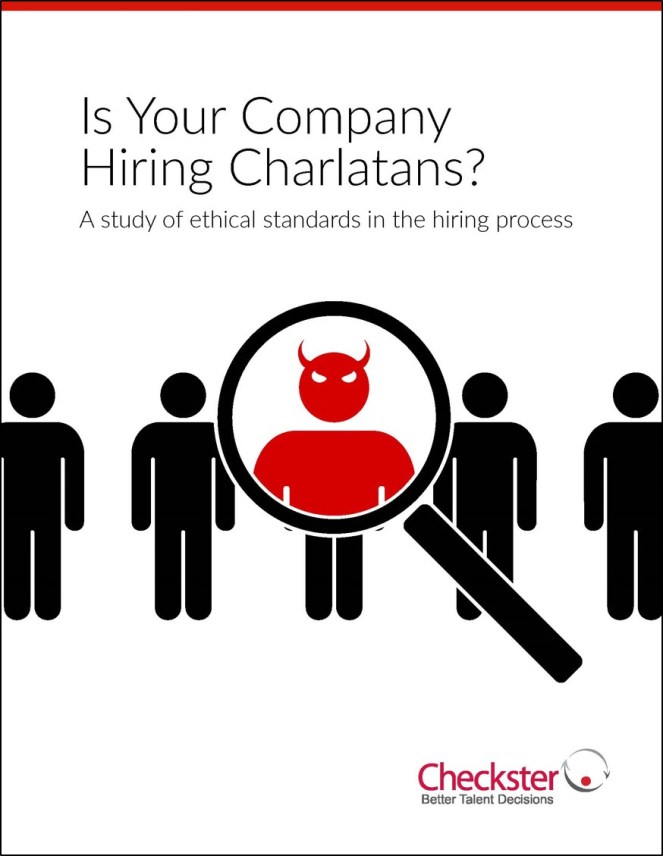
When Is It Okay To Lie?

400 hiring managers reveal when it’s okay to lie on your résumé.

I’ll admit the headline was intriguing even as I was recently reviewing my own résumé.  The study conducted by Checkster, a talent recruitment company, was intended to pull back the curtain on the hiring process.  What was revealed was pretty insightful.  Of the 400 applicants polled, 78% misrepresented themselves in some form or fashion:

  • 60% claim mastery in skills in which they are not masters
  • 50% claim longer tenures at jobs to omit an employer
  • 45% falsify reasons for leaving a prior job
  • 42% make up relevant experiences
  • 41% alter titles, such as “manager” to “director”
  • 39% claim a degree from a more prestigious university

What I found even more compelling was the reaction from hiring managers.  In the same study, some 400 hiring managers were also polled and two-thirds of them said they would hire liars anyway, when other good candidates are not available.  What they won’t tolerate is faked references, which they say is the worst thing an applicant can submit.  By the way, 43% of applicants in this study conceded they have or would fake references.  Hiring managers are most understanding about inflated GPAs. Nearly all (92%) said that they would still consider hiring someone who had increased their GPA by more than half a point.

Checkster

I decided to dig a little deeper on this topic and defaulted to one of my journals I review occasionally.  As luck would have it, in October 2019, the Journal of Applied Psychology included an article entitled “Liar! Liar! (when stakes are higher):  Understanding how the Overclaiming Technique can be used to Measure Faking in Personnel Selection.”  Purportedly, this is a first of its kind type of study.  What the researchers found was that those who “overclaimed more during their job applications also tended to engage in deviant behaviors and demonstrated poorer performance on a task they were hired for.”

I’ve been thinking about character and integrity a lot this week and wrestling with how we balance the pressure to perform with the reality of limitations.  As leaders, if a team member has oversold himself or herself what should your response be?  As these studies we’ve just reviewed might suggest, it depends.  And therein lies one of the hard parts about this job and so many others.  There’s an ancient proverb that says “a half truth is a whole lie.”  There is also a part of me that knows if you don’t trust those who are tasked with coaching you up you will most likely fake the part.  Here’s some friendly advice on this day of amor – if you cut the stems too short on the flowers just own it; don’t wedge them in a vase too small so they stay tall and suspended.  Sooner or later they are going to fall down…