
You Can’t Pour From An Empty Cup

This past Tuesday during our monthly school board meeting a middle school teacher gave testimony as part of a larger presentation on instruction to students learning English as a second language.  You knew instantly when she began speaking she had a message worth hearing and by the end of her speech she received a standing ovation.  I’m not talking about the polite gesture folks engage in out of compliance and being nice, where it’s that domino effect when one person stands, then another, then another, slowly but surely until everyone is standing only to sit back down.  I’m talking about a shared response that timed its immediacy with its enthusiasm.  She was just that good.  I don’t want to draw too much attention to her but for those familiar with navigating our website I can’t stop you from checking out the video.  The body of the entire presentation was plenty polished but when this teacher spoke you just listened.  She shared with the audience an artifact posted in her classroom which reminded her students of four truths spoken through the student voice:

  • I am important.
  • What we are learning is important.
  • I can do it.
  • My teacher will not give up on me.

I gave my own speech today to students placed at our disciplinary alternative campus and largely borrowed truth #4.  It’s an interesting dynamic because on the one hand students placed there have consequences needing to be enforced but at the same time they need to stay connected, current, and in good standing.  They also need reminders – lots of them – and I’m not talking about rules.  The kids I spoke with today were mostly kids of color, have had their share of ups and downs in school, may or may not be looking forward to the holiday break, but they all deserve to feel valued and respected.

This leads me to the title for this entry.  At the beginning of this month, December 1st to be exact, Rev. Howard-John Wesley of the historic Alfred Street Baptist Church in Alexandria, Va., told his congregation he was going on sabbatical.  In an emotional sermon shared with congregants, the reverend acknowledged he was tired.  While his message was certainly a churchly one, the overarching theme transcends its religious base.  If you are interested, you can watch the recording in its entirety by clicking the screen grab below.
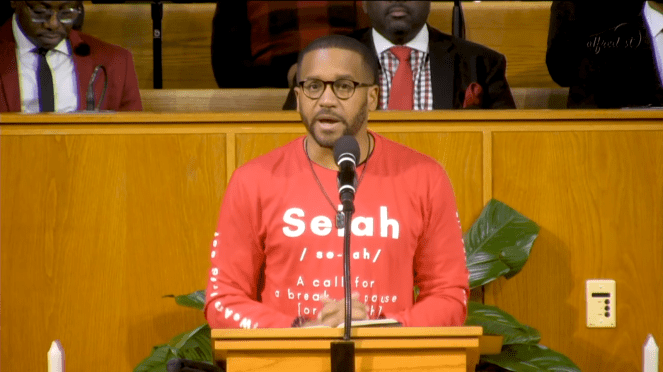
Rev Wesley

But Rev. Wesley makes a key distinction between being tired and being exhausted.  He contends “exhausted is right before burnout” and that he is still excited about pastoring his church but in order to lead it he needs to be refilled.  And in his own words a nap is not going to fix his tiredness.  He needs to rest.  At one point during the sermon in full throttle energy mixed with humor he exclaims “it is ungodly not to use up all your vacation days.”  But he did not make light of the goals he has for himself and his candor was remarkably brave.  He charged his church family with being courageous, trusting, persistent, faithful, and prayerful in his absence.  And by the end he too received a standing ovation.

As we draw this semester to a close, Selah.  It’s the term spoken throughout Rev. Wesley’s sermon meaning to pause and reflect, to rest.  Take time to refill and recharge, and recommit to this important work.

Acknowledgment Means Everything

I read this article not long ago and since then there has been a recurring theme in other news-related items that I have come across.  In 1981, Joe Purzycki was named head football coach for Delaware State University, a Division I-AA historically black university in Dover, Delaware.  Prior to Purzycki’s appointment, the Hornets went 2-9 the year before and included the most lopsided loss in Division I-AA football history (a 105-0 pummeling from Portland State which led 49-0 after the first quarter).  Nelson Townsend was the athletic director at the time who hired Purzycki; Townsend is black and Purzycki is white.  Turns out Purzycki became the country’s first white head football coach of a historically black college or university (HBCU).  Over the course of four seasons, the Hornets saw dramatic improvements and finished 8-2 in Purzycki’s final season with the team.  Nearly forty years later the coach coauthored a book on his experience at Delaware State and how common ground was established despite all the racial tension by never failing to acknowledge what his players had experienced.

Mr. T and the Polish Prince_small

A principal in Minnesota provided the ultimate lesson in acknowledgement when he surprised his 7th grade student last week.  Jonathan Jones attends Lakeview School in Cottonwood, MN, and his principal is Scott Hanson.  It turns out the student and principal have a special connection in that they are both extremely color blind.  For Jonathan, doctors first identified this condition three years ago although he likely has had it since birth.  For his principal, it has also been a lifelong condition but he has specially designed glasses which increase the contrast between shades and help to reduce the symptoms of color blindness.  With Jonathan’s parents on hand, this principal served as a guest instructor during Jonathan’s science class and allowed him to try out his special glasses.  It took less than ten seconds before Jonathan was overcome with emotion in a now viral video.  The full story can be found here and his principal’s reflection speaks volumes.  “I’ve been in education for 25 years, and to see that reaction on his face, and that pure joy and overwhelming happiness and sadness, all those emotions at once, was just an awesome experience.”

And then there is Dhruv Gaur, the reigning college champion on Jeopardy.  When competing last month in the annual Tournament of Champions, he wrote this message for his Final Jeopardy answer.

Jeopardy

The clue was “In the title of a groundbreaking exposé of poverty in New York City slums, these three words follow ‘How the,’ ” and the answer-in-the-form-of-a-question the beloved game show host was looking for was, “What is ‘Other Half Lives?’”  Trebek had shared with the contestants before the show that he was reentering treatment for pancreatic cancer.  Gaur was in a distant third place when they got to the last question so he instead took the opportunity to offer support (you can click the image above for the complete story).  In his own words, Gaur recalls “Obviously I wasn’t going to win the game or anything, so I could try to figure out the right answer or I could do something for this person who might need it right now.”  After thirty five years leading the iconic game show, a simple gesture almost brought the steady showman to tears.

Acknowledgments are powerful testimonies and sometimes they just might mean everything.