
Marshmallows

My senior year in high school I took a two-part class with one semester on psychology and the other semester on sociology.  Psychology was in the fall and by the time I started college it was a declared major.  The study of the mind just seemed to connect with me on many levels and so I continued to learn as much as I could through my undergraduate and graduate pursuits.

Last week, Walter Mischel, at the age of 88, passed away.  If you’re not familiar with arguably one of the most influential modern-day psychologists, you may have heard of his signature research on self-control and will power.

More than five decades ago, Mischel and his colleagues began working with four-year-olds in a series of experiments to test their ability to delay gratification.  Preschoolers would be presented with two marshmallows and told if they could hold off on eating one for fifteen minutes while the researcher left the room, then they could have the second one also.  If they wanted to not wait and eat just one, they would simply ring a bell for the researcher to return before time was up.  Fewer than one in three children could hold out!  Some of the control groups, however, did much better in delaying impulse when they were provided strategies for shifting their attention.  Years later, Mischel and his team followed up with the preschoolers and found that children who had waited for the second marshmallow generally fared better in life.

The research sought to identify the cognitive skills that underlie willpower and long-term thinking and how they can be enhanced.  Mischel’s aim was not to predict who would be successful or not but rather how can people be trained and empowered to control their own attention and thoughts.  In a more recent NPR interview, he sums it up himself the best I believe.  “What my life has been about is in showing the potential for human beings, to not be the victims of their biographies — not their biological biographies, not their social biographies, and to show, in great detail, the many ways in which people can change what they become and how they think.”  Mischel sounds like a rock star teacher to me!  His work has often been misunderstood and he wasn’t suggesting one’s destiny is determined by a sweet treat.  He was trying to show the world the power of thought and how it can shape one’s future.
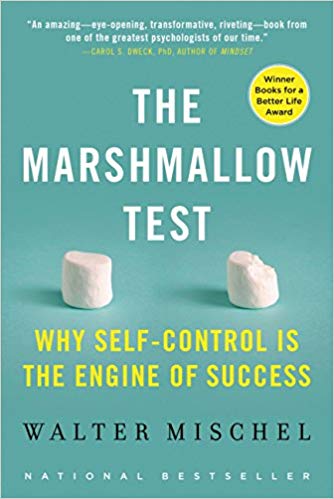
TheMarshmallowTest


Character Revealed

On Saturday, 09/08, Naomi Osaka defeated Serena Williams and became the 2018 U.S. Open women’s singles champion.  The twenty-year-old phenom claimed her first grand slam title along with a historic $3.8M victory check (Williams, at age 36, has 23 major victories).  If you were like me, you read about this feat the next day sifting through all the controversy that also surrounded the event.

To quickly recap, the first ever Japanese-born grand slam tennis player bested her childhood idol in every aspect of the game.  Osaka dominated Williams, claiming a 6-2, 6-4 straight set victory.  But what has overshadowed Osaka’s brilliant play was a series of exchanges between Williams and the chair umpire during the second set.  With Williams down one set and just into game two of set two, the official proceeded to charge her with a code violation.  The first resulting penalty was a warning to Williams for allegedly receiving coaching (coaches are not courtside but in the stands and during the big events are not allowed to instruct their athletes).  Williams contested the warning but kept playing and was able to establish a 3-1 lead before quickly surrendering the momentum by losing the very next game.  Now the game count stood at 3-2, and Williams smashed her racket on the ground while walking off.  This outburst led the chair umpire to assess her with her second code violation and resulted in the loss of a game point.  Osaka went on to win that game and square the set at 3-3.  When she proceeded to win the next one as well Williams’ emotions boiled over and she laid into the chair umpire during the changeover.  At this point the official called another code violation on Williams for verbal abuse, and the resulting penalty was the loss of an entire game, instantly changing the score from her being down 4-3 to being down 5-3.  Osaka would go on to claim the second set 6-4 and the match.

Earlier this week, Osaka was invited to appear on The Ellen DeGeneres Show and the six-minute feature was pure inspiration in its simplicity.  The tennis star was poised but clearly nervous and out of her comfort zone.  And to Ellen’s credit, she immediately made their time together about Osaka, the college-aged kid who happens to have enormous tennis talent but many of the same interests and insecurities as her peers.  When asked about what Williams quietly shared with her following the match, Osaka revealed her idol said she was proud of her and you could see the profound impact that affirmation had on her.  As educators, how often have we seized on timely moments and made lasting impressions?  Small gestures aren’t necessarily simple ones.  And as observers, how often have we seen these exchanges take place? The scene that unfolded at last Saturday’s U.S. Open was raw and ugly and unsettling, yet two champions emerged.  That should be our end goal every time.

Heat Islands and Food Deserts

Today is my birthday and it seemed like as good a day as any to launch this site.  As a public school administrator, my route to this role has been less typical but in most ways, it has been by design and desire.  What I’ve learned along the way is I usually have an answer to a question, it just might not always be the right one for a given circumstance.  This is where you, the reader, come in.  My goal for this blog is to present topics of interest (hopefully) and through audience participation extend the discussion.  And maybe this exchange will lead to a new “what if” or “why not” that makes this day more informed than those before it.

It’s hot in Texas!  We’re a week into September and still seeing 90 degrees outside.  Forecasters have already indicated the Lone Star State is on track for the second hottest summer on record, trailing only the record-breaking year of 2011.  But despite the heat, I have choice in how hot I choose to be.  The temperature in my house is set at 75 degrees and the master bedroom stays at 73 degrees, with fans no less.  I come to work early and leave late, all while in a comfortably cooled office.  On weekends the outdoor and leisure activities definitely change things but I like it that way.

I came across an article recently that suggested poor city neighborhoods are often much hotter than wealthy ones (The Washington Post, 09/02/2018).  Beyond the more obvious reason for this due to affordability of air conditioning, low-income areas are prone to “heat islands” which is a term used to represent communities with little vegetation and lots of concrete.  They lack greenery, public parks, adequate landscaping, and so forth.  These parts more often lack indoor respites like movie theaters and malls and share another phenomenon – food deserts.

After I read this article I went for a drive around town and randomly toured some of our schools.  I’ve always paid particular attention to a school system’s buildings and grounds because I believe it says a lot about an organization.  Neighborhood schools are just that, and we often discuss the bell-to-bell order schools provide to students in otherwise stressful circumstances.  Imagine if the school house not only was the source of social emotional comfort but also that much needed physical comfort we may not have recognized.  Certainly this year has offered new excitement as we welcomed kids back and even though there are many variables beyond our control, paying attention to the details is a responsibility we can all share.